Microgreen seeds

When my pea crops stopped producing, I allowed those pods that had become to mature to dry on the vine. When shelled, this yielded 3 lbs of snow pea seeds and 2 lbs of shelling pea seeds. I will use these to produce microgreen pea shoots over the winter. This amount of seeds purchased commercially would cost $80-$100 including shipping.

Fig Baklava Tarts

Fig Baklava Tart

We have a bumper crop of fresh white figs.  They shine in this recipe.

  • 1/2 cup water
  • 1/3 cup honey
  • 1 strip lemon peel
  • 1 Cinnamon stick
  • 6 fresh figs (quartered lengthwise (about 5 ounces))
  • 3/4 cup finely chopped walnuts
  • 2 tablespoons light brown sugar
  • 1/2 teaspoon ground cinnamon
  • 1/8 teaspoon ground cloves (optional)
  • 1/4 cup olive oil
  • 1 tablespoon unsalted butter (melted)
  • 6 sheets phyllo dough
  • 1 tbsp lemon juice
  1. Combine the water, honey, lemon peel, lemon juice and cinnamon stick in a medium saucepan over medium-high heat. Once the mixture begins bubbling, reduce the heat to medium-low and add the figs. Cook for 4 to 5 minutes, until they are until tender but still retain their shape. Use a slotted spoon to transfer the figs to a bowl.
  2. Remove the cinnamon stick and lemon peel from the saucepan and discard. Increase the heat to medium-high; cook the remaining liquid for about 2 minutes, or until it has reduced to a syrupy 1/2 cup. Let cool.
  3. Preheat the oven to 350 degrees.
  4. Combine the walnuts, brown sugar, cinnamon and cloves, if using, in a small bowl. Combine the oil and melted butter in a separate bowl.
  5. Set the stack of phyllo dough on a clean work surface and cover with damp paper towels, keeping the stack covered as much as possible as you work. Transfer one sheet of the phyllo to a large cutting board, and brush the top with the oil-butter mixture. Lay another sheet directly on top of that one and brush it with the oil mixture. Repeat with the remaining sheets of phyllo.
  6. Use a sharp knife to cut the phyllo stack into 6 4″ squares. Press one stack of the squares into each well of 2 6-well muffin pans.  Fill each cup with equal amounts of the walnut mixture, then bake (middle rack) for 13 to 15 minutes, until the phyllo is crisped and golden.
  7. While the phyllo is still hot, drizzle the cooled syrup into each of the phyllo-walnut cups (in the muffin pan). Top each with 2 pieces of fig; cool to room temperature before serving.

Modified from Ellie Krieger recipe, published in Washington Post , 8/9/2017

Planting Fall Veg

Half of the bed of potatoes was harvested last night. The bed was rototilled, covered with 200 lbs of compost mixed with 1 lb of bone meal, and planted with transplants of lettuce, various members of the cole family, endive and kale (lacinto and red Russian varieties). To help the young plants along I laid down new drip tape.

Basil smells like summer

Basil in the garden is coming on beautifully. I pinched off some tips that were threatening to form flower buds and the leaves from these, pictured here, made beautiful pesto.

Basil Pesto

  • 200 grams basil leaves
  • 70 grams walnuts (or pine nuts if you are wealthy)
  • 70 grams Parmesan cheese
  • 30 grams garlic
  • 1 cup extra virgin olive oil
  1. Process walnuts, cheese and garlic briefly in a food processor.  Add salt and black pepper to taste, then add basil leaves and process until finely chopped. With the processor running, stream in the olive oil.

    Pesto freezes well, so you may wish to place a portion of this in a small Tupperware type container for freezing.

Retrospective – building our high tunnel hoop house

Starting in January, we covered the construction site with a tarp to kill the grass.

The site was then rototilled…

We built the hoophouse roughly according to the instructions provided by Johnny’s Seeds. The hoops for the high tunnel are just top rails for chain link fence (1 3/8″, available at Lowes). We bent these using a homemade pipe bender, fashioned by cutting a 7′ radius arc into a 2″x10″ board.

The hoops were mounted on posts driven into the ground, and then covered with 6 mil UV-resistant green house poly film.

The glacier left us presents.

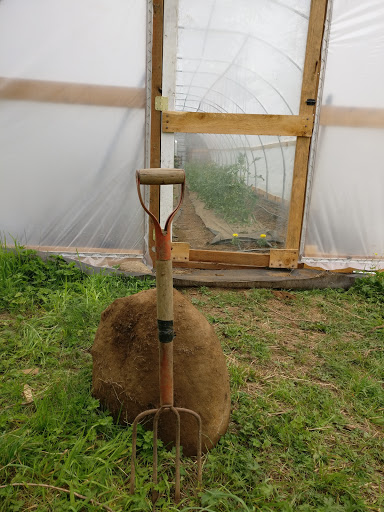
Part of the job of preparing beds in our newly constructed high tunnel hoop house is removing more than a few large rocks of varying size lurking just beneath the surface of the soil..  I pulled this one out last night.  It is, by no means, not the largest rock I have extracted.

A glacier really did a number on our Skykomish river valley during the last ice age. Our top soil, ranging in depth from 1′ to 2′ in thickness, sits on top of a concrete-like layer of sand and gravel compressed by the huge pressure of the passing glacier. Sitting on top of this compressed layer are rocks ranging in size from soft ball size to automobile size.