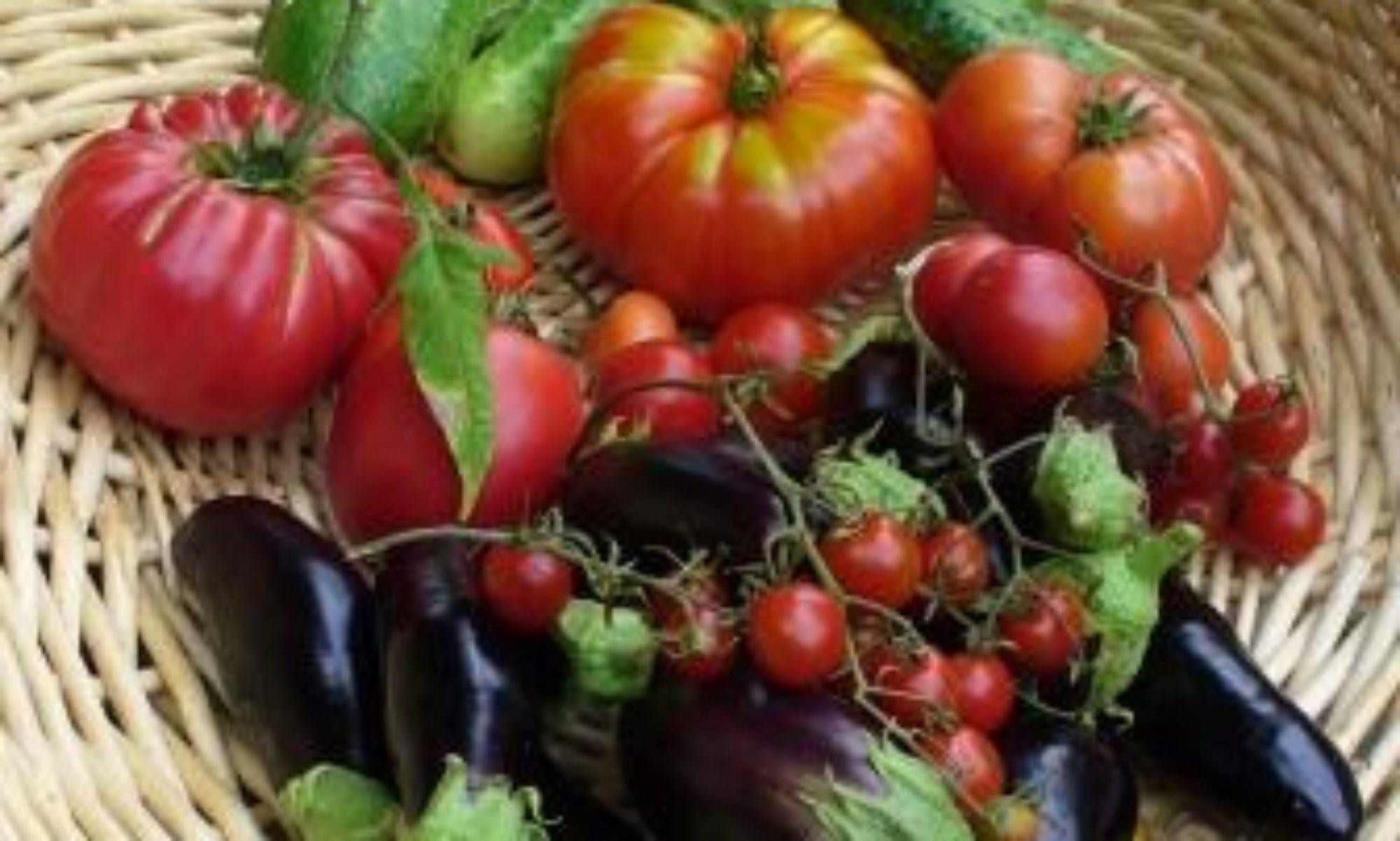
I don’t know whether to credit global warming, or my new regimen of growing my tomatoes vigorously pruned and trained to vertical posts, but this is the first time in many years I have made it to the first of July without any sign of late blight. Growing tomatoes trained in this way prevents ground contact and improves air circulation – both helpful in preventing attack by the blight fungus. In the Puget Sound region we invariably have a number of days of cloudy, moist and relatively warm weather in June, which the blight fungus loves. This year my tomatoes survived June unscathed and in phenomenally good shape. The majority of my 120 varieties of tomatoes already have fruit. Shown below is Alicante, a British variety, which fruits early and productively, even in cool climates.
Training tomatoes
The key to training tomatoes to a vertical support is illustrated in the picture below.

Tomato plants branch by growth of buds that form at the Y between two existing branches. The bud in the upper panel has been removed in the lower panel by simply pinching it off. These buds grow amazingly fast in warm weather, so buds need to be removed weekly. Left unchecked, each bud forms a branch that will form more buds and branches, so the number of vines grows exponentially, from 2 to 4 to 8 to 16, etc. If you remove buds properly you will end up with a single vigorous vine, which will easily grow 6′-8′ or more up a support.
A high stakes proposition
This year, for the first time, I am training my tomatoes on tall stakes. This involves frequent pruning of the plants to remove the buds that form at branch nodes, so that the plants grow as one or two long vines, tied to bamboo poles at 10 inch intervals. The process of pruning and tying 120 different plants takes much less time than I imagined it would. In theory, growing plants vertically in this manner will improve air circulation around the plant, to reduce the possibility of the plants developing late blight. I must say, the plants look wonderously healthy so far, so fingers crossed.
Here is the list of tomato varieties I am growing this year
| Variety |
| Abe Lincoln |
| Alaska |
| Alicante |
| Amish Paste |
| Ananas Noir |
| Anna Russian |
| Argentina |
| Aunt Ginny’s Purple |
| Aunt Lucy’s Italian Paste |
| Austin’s Red Pear |
| Beam’s Yellow Pear |
| Besser |
| Black Cherry |
| Black Krim |
| Black Pear |
| Black Plum |
| Black Prince |
| Bloody Butcher |
| Bonnie Best |
| Boxcar Willie |
| Brad’ Black Heart |
| Brandywine (Landis Valley) |
| Baselbieter Roeteli |
| Buckbee’s New 50 Day |
| Burraker’s favorite |
| Bush Beefsteak |
| Camp Joy |
| Carmello |
| Caspian pink |
| Cherokee Green |
| Chianti Rose |
| Costoluto Genovese |
| Coyote |
| Cream Sausage |
| Cskos Botermo |
| Cuostralee |
| Dagma’s Perfection |
| Debarao |
| Delicious |
| Earl of Edgecomb |
| Early Wonder |
| Eva Purple Ball |
| Fireworks |
| First Pick |
| Flamme |
| Forme de Cour |
| Fred Limbaugh |
| Galina grande |
| Gigantesque |
| Gill’s All Purpose |
| Grandpa’s Minnesota |
| Green Zebra |
| Hezhou |
| Holland |
| Ilse’s Yellow Latvian |
| Impulse |
| Indische Fleiche |
| Ispolin |
| Italian Tree |
| Kellog?s Breakfast |
| Kimberly |
| Koralik |
| Lahman pink |
| Long Keeper |
| Manitoba |
| Manyel |
| Marglobe |
| Marianna’s Peace |
| Marmande |
| Martino?s Roma |
| Mexico |
| Mom’s Paste |
| Money Maker |
| Mr. Brown |
| Mrs. Maxwell Big Italian |
| Mule Team |
| Napoli |
| Neve’s Azorean Red |
| New Hampshire Surecrop |
| Nyagous |
| Old Brooks |
| Old German |
| Olga’s Round Yellow Chicken |
| Panatero Romanesco |
| Paul Robeson |
| Pink Ponderosa |
| Porter |
| Prescott |
| Purple Russian |
| Quedlinburger Fruehe Liebe |
| Red Pear |
| Red Siberian |
| Riviera |
| Russian Big Roma |
| Rutgers |
| Saint Lucie |
| Saint Pierre |
| Salisaw café |
| San Marzano |
| Sasha Altai |
| Sausage |
| Sebastopol |
| Sister |
| Slava |
| Stupice |
| Sunsets Red Horizon |
| Tiffen Mennonite |
| Tigerella |
| Tondino di Manduria |
| Wapsicon Peach |
| Watermelon beefsteak |
| Wisconsin 55 |
| Yellow Pear |
| Zarnitza |
Lament of a wet spring
We had the second-wettest February on record in the Puget Sound, followed by the wettest March ever recorded, so needless to say, I haven’t made much progress preparing the garden for planting. That has left more time in the greenhouse, so my tomato starts (120 mainly heirloom varieties) are doing well.

Spring?
The weather today doesn’t look the slightest bit Springy. The sky has been spitting rain 24/7 for days, and daytime temperatures for the last week have hovered around 38 degrees F. F is an abbreviation for F’ing cold. Still, it appears that Spring is around the corner because A) Lucy, my border collie, is shedding fur in gross handfuls and B) a love-sick pileated woodpecker has begun pounding on the beams in my barn because he loves the way the metal roof amplifies the sound.
So…. ignoring the weather and heeding these clues of impending Spring, I have begun planting flats with seeds. Yesterday I planted onions (Ailsa Craig Exhibition, Ringmaster White globe, Red Globe, and Early Yellow Globe) leeks (Carentan), flat leaf parsley, Broccoli (Waltham 29, Romanesco) and lettuce (Winter Brown, Lavigna). Today, I am planting fennel (Florence), celery (Utah 52-70), celeriac (Giant Prague), King Richard leeks, and Early Jersey Wakefield Cabbage. Seeds are loosely scattered in flats of commercial potting soil, and flats sit on the floor of my “mudroom” covered with plastic film. One flat sits on a warming pad, but as I only have one small pad, the other flats just depend on the nearby wall heater for warmth. The flat on the pad will undoubtedly sprout seeds first. As soon as sprouts appear, the flats will be transferred to my greenhouse, where they will sit on a thermostatically heated bed of sand.
Leg of Lamb
A rare December sunny day let me do some work cleaning up the veg garden. Fortunately, X-mas dinner featured a roast leg of lamb. I had a free 1 1/2 hour while it was in the oven. My garden’s Brussel sprouts survived our recent -15 F freeze, so they were tossed with olive oil and baked as well, along with russet Burbank potatoes and delicate squash, all from the garden.
- 1 leg of lamb, bone in (6 lbs)
- Juice of one lemon
- 6 cloves garlic, minced
- 3 tablespoons chopped fresh rosemary leaves
- 1 tablespoon salt
- 2 teaspoons coarsely ground black pepper
- For sauce –
- 1 cup chopped fresh rosemary and parsley
- One medium onion, diced
- 2 cups chicken stock
- 1 cup red wine
- Preheat the oven to 400 degrees F.
- Sprinkle the lamb with the lemon juice.
- Combine minced garlic, chopped rosemary, salt and pepper.
- Pat the mixture evenly all over the surface of the meat.
- Season the meat with the salt and pepper and place in a roasting pan.
- Roast for 30 minutes. Reduce the oven temperature to 350 degrees F and continue to cook for about 1 1/2 hours longer for medium-rare.
- Meat thermometer inserted into the center of the roast should register 146 degrees. Remove lamb from pan and allow to rest for 10 to 15 minutes before carving.
- Meanwhile, prepare sauce.
- Position the roasting pan over stove burners.
- Add mixed herbs and onions to pan, and stir to combine with pan drippings.
- Add chicken stock and wine to deglaze the pan.
- Reduce over high heat until to thicken. Strain before serving.
- Slice lamb and serve with sauce drizzled over the top.
Merry Seed Day
This is the time of year when our mailbox becomes clogged with seed catalogs. It is a trap. The seed merchants clearly share mailing lists. Purchasing seeds from one merchant will cause catalogs from 5 merchants to show up in the mail. I exercised some self-restraint, and didn’t make purchases from any of these merchants. However, I did go on-line to take advantage of sales prices to purchase a few packages of seeds from Johnny’s Selected Seeds and Territorial Seeds.

Global warming II
Over 20 years, my total yield of Brown Turkey figs never exceeded 6 figs in any year. This year, I have far more figs than I can pick or eat. The excess inspired me to make a figgy pudding, but with the dry figs and water of the recipe replaced by 20 fresh figs. Outstanding!


You must be logged in to post a comment.